
Clinical trials rely on numerous sources of information that must be controlled
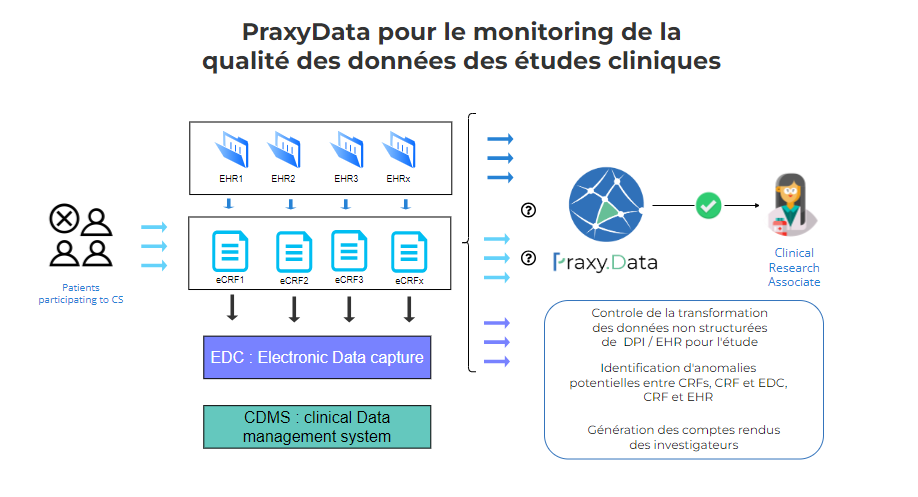
Although largely dematerialised, clinical trial data collection systems do not yet connect to EHRs. Thus, clinical and biological data from EHRs are manually retranscribed into electronic observation notebooks (eCRF). The re-entry of this data, which represents, according to the trial protocol and the content of the source EHR, 13 to 75 % of clinical trial data, mobilises many resources today and is a source of avoidable errors

1. Integration into your control plan
Our solution supports and strengthens the control plan defined by clinical research associates by controlling the consistency between external data sources and entries in the EDC or CDMS. We define together an application perimeter and a list of entities to be controlled and consistency checks based on medical language analysis.

2. With the ability to analyse 100% of CRF and CR medical records from the DMP
The language analysis technologies we develop enable us to analyse in bulk thousands of reports and identify inconsistencies between different databases/sources. The precision achieved varies depending on the entities to be extracted, it is generally in the order of 85% to 95%, which makes it possible to reduce the cost of controls

3. Investigations can be supported by our PraxyConsultation tool
In the event of patient calls to conduct investigations, our PraxyConsultation solution for interview summary and structured data extraction can also be mobilised to save time and improve precision See PraxyConsultation . These data are of course reviewed and validated by the investigator

HDS SaaS or on-premise solution
Pay-per-use payment
depending on the number of errors detected and the precision of error detection
Precision gain
for clinical research associates: PraxyData allows you to check 100% of observation notebooks and medical records
Scalability and speed
The solution is quickly deployed to control thousands of files